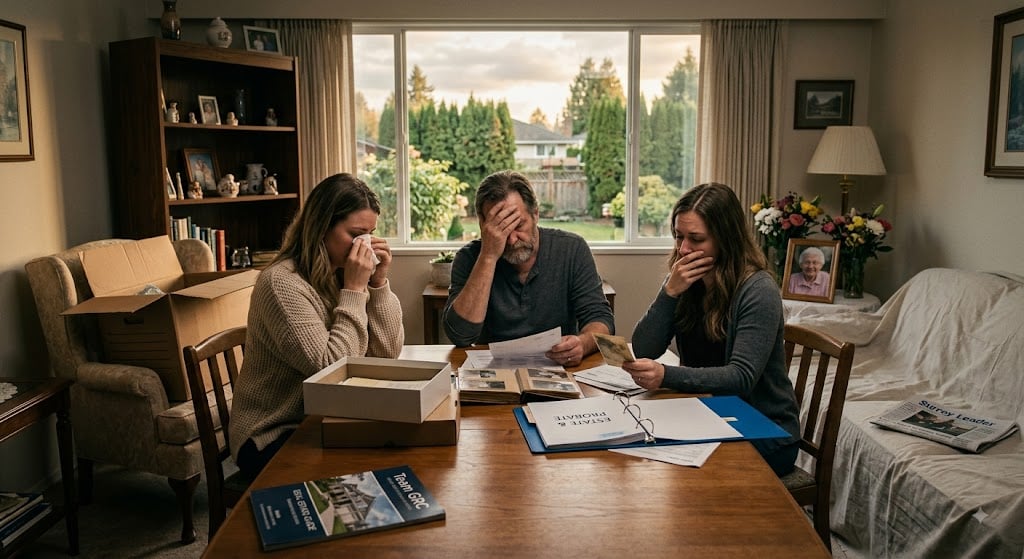
First, we're sorry for the loss that's brought you here. Inheriting a property is rarely just a financial event it usually comes wrapped in memories, family, and a hundred small decisions nobody prepared you for. Our goal with this guide is simple: to help you feel oriented, so the process feels less overwhelming and you know what's coming.
We've walked many Surrey and White Rock families through this, and the first thing we tell everyone is the same: there's rarely any need to rush. Take the time you need. Here's the shape of it.
Do you need probate to sell?
Probate is the court's confirmation that a will is valid and that the executor has the authority to deal with the estate. In British Columbia, when real estate is involved, probate is usually required before the home can be sold. The Land Title Office and most buyers will want to see a grant of probate before the sale can complete.
There are exceptions for very small estates, and every situation is different — this is one of the moments where a short conversation with a lawyer or notary is worth it. But if a house is the main asset, it's safest to assume probate will be part of the journey, and to start early so it doesn't hold up a sale later.
What does probate cost in BC?
British Columbia charges probate fees based on the value of the estate. As a rough guide:
- Estates under $25,000: generally no probate fee.
- On the value between $25,000 and $50,000: about $6 per $1,000.
- On the value above $50,000: about $14 per $1,000.
- Plus a $200 filing fee for estates over $25,000.
So a $1.5 million estate carries a probate fee in the region of $21,000. It's a real cost to plan for, but it's usually a small fraction of the estate's value — and it's paid from the estate, not out of your own pocket.
Will you owe tax on the inheritance?
This is the question that worries people most, and the answer is more reassuring than most expect: Canada has no inheritance tax. You don't pay tax simply for receiving a property.
Instead, taxes are settled on the estate's final return. When someone passes away, the Canada Revenue Agency treats their property as if it were sold at its market value on the date of death. If the home was the person's principal residence — their main home — the principal residence exemption usually means little or no capital gains tax is owed on it at all.
And here's the part that helps when you go to sell: you inherit the home at its value on the date of death. If you sell it soon after, any further gain is typically small — and only half of a capital gain is taxable in Canada. In many cases, families selling an inherited main home within a reasonable time owe little to nothing in capital gains. Your accountant can confirm the specifics for your situation, but the headline is usually good news.
A realistic timeline
Most families ask, "How long will all this take?" In BC, probate itself commonly takes a few months, and selling follows from there. Start to finish, six to twelve months is a realistic window, though it varies with the estate's complexity and whether there are multiple heirs.
The good news is that a lot can happen in parallel. While probate is being sorted, you can be getting the home ready, understanding its value, and planning the sale — so that when the grant comes through, you're ready to move.
Preparing the home — gently
Clearing out a family home is often the hardest part emotionally. There's no right speed, and you don't have to do it alone. When families ask us for help, we coordinate the practical side — cleaning, minor repairs, staging, photography — so the home shows at its best without the weight falling entirely on you.
Sometimes a few small, well-chosen improvements make a meaningful difference to the final price. Other times a home is best sold as-is. We'll give you an honest opinion either way, with no pressure to spend money that won't come back.
Selling with multiple heirs
When several family members share an inheritance, the property decisions can become the hardest conversations of all. It helps enormously to have a neutral, experienced third party in the room — someone whose job is simply to present the facts, the value, and the options clearly, so the family can decide together with good information in front of them. That's a role we're glad to play.
You don't have to figure this out alone
We've guided many Surrey and White Rock families through exactly this — calmly, respectfully, and at whatever pace feels right. If you'd like a no-pressure conversation, or just a few honest answers, reach out to Team GRC or try our free inherited-property guide. There's no obligation, and no rush.